
How to Choose the Right Cabinet Hinge in 2026?
Choosing the right Cabinet Hinge in 2026 requires more than matching a finish to a kitchen door. The hinge must suit the cabinet’s construction, door weight, opening angle, and daily use. A concealed hinge may work well on a modern frameless cabinet, while a face-frame cabinet often needs a different mounting plate. Small differences matter. A 3-millimeter misalignment can make a door scrape, sag, or fail to close smoothly.
This guide explains the practical decisions behind reliable hinge selection. It considers overlay, inset, soft-close performance, load capacity, corrosion resistance, and adjustment range. These details become obvious during installation. A heavy oak door places more stress on screws and hinge arms than a lightweight laminate panel. Moisture near a sink also changes the performance requirements. Manufacturer specifications should always be checked against the actual cabinet design. Guesswork can be expensive.
Not every premium hinge is the best choice. A costly model may offer features that the cabinet never needs. In contrast, a basic hinge can fail when its load rating is ignored. That is an easy mistake to make. The most dependable choice balances engineering, installation experience, budget, and long-term maintenance. Test the movement before fitting every door. Check the screws. Watch the gaps. A perfect-looking installation may still reveal weaknesses after months of use. This article offers a careful framework, while recognizing that cabinet materials, installer skill, and household habits can change the final result.
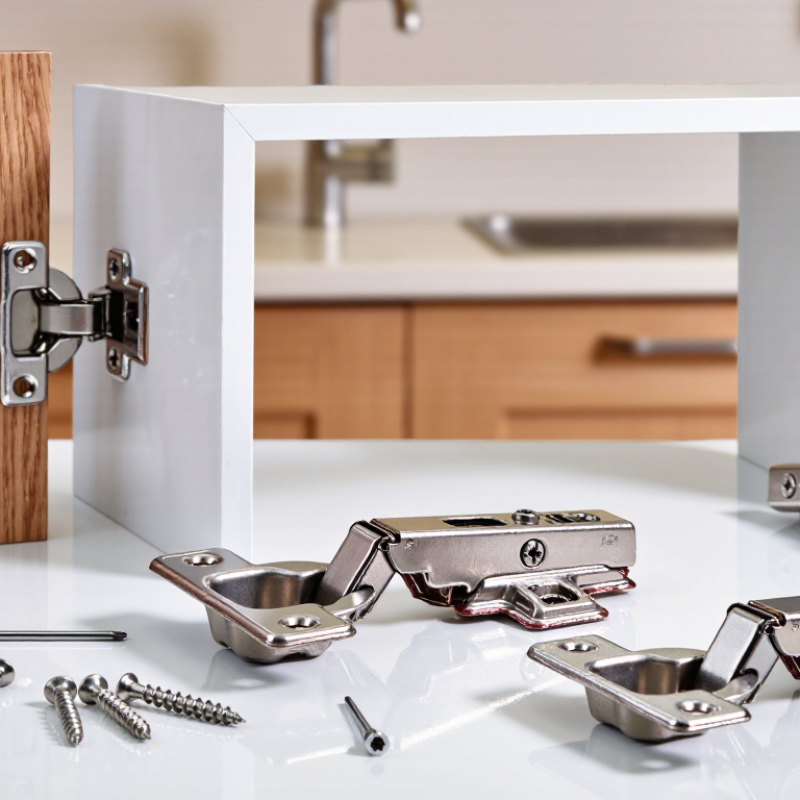
Define Your Cabinet Door, Frame, and Overlay Requirements
How to Choose the Right Cabinet Hinge in 2026?
Start with the cabinet door, not the hinge. Measure its height, width, thickness, and weight, including glass or metal inserts. A tall pantry door may need stronger support than its appearance suggests. It also needs enough opening clearance beside nearby doors, walls, and handles.
Check the cabinet frame carefully. A face-frame cabinet has a visible wooden frame around the opening, while a frameless cabinet has exposed interior edges. This difference determines the hinge style and mounting position. Then define the overlay: full overlay covers nearly all of the frame, half overlay shares the frame with another door, and inset doors sit inside the opening. Small errors here can create uneven gaps.
Use a tape measure and record the reveal on every side. Do not assume matching doors have identical measurements. They may not. Choose hinges with suitable weight ratings, adjustment ranges, and opening angles. Soft-closing hinges can reduce impact, but they cannot correct a badly aligned door. That part is easy to forget. In practice, a 1–2 millimeter error can become obvious across a wide cabinet. Check the hinge cup position, door thickness, and frame clearance before drilling. A paper template helps, though it is not foolproof. Test one door first, inspect the gaps, and revise the layout before fitting the remaining hinges.
How to Choose the Right Cabinet Hinge in 2026? - Define Your Cabinet Door, Frame, and Overlay Requirements
| Requirement to Define | Typical Options | Recommended Hinge Choice | Key Dimensions or Ratings | Selection Guidance |
|---|---|---|---|---|
| Cabinet construction | Frameless box; face-frame cabinet | Select a hinge mounting system that matches the cabinet structure | Concealed hinges commonly use a mounting plate; face-frame versions use a frame-compatible attachment | A hinge designed for a frameless cabinet does not automatically fit a face-frame cabinet without the correct mounting solution. |
| Door overlay | Full overlay; half overlay; inset | Use a full-overlay, half-overlay, or inset hinge configuration | Overlay is the amount by which the door covers the cabinet side or frame; measure it in millimetres | Do not select an overlay hinge by appearance alone. Confirm the door thickness, cup position, mounting plate height, and cabinet construction. |
| Door position | Door outside the cabinet; door partly covering the divider; door inside the opening | Full-overlay, half-overlay, or inset concealed hinge respectively | Inset doors require clearance between the door edge and cabinet opening | For inset doors, verify the reveal on all sides and the hinge's minimum required edge clearance. |
| Door thickness | Thin panel; standard panel; thick or solid-wood door | Choose a hinge rated for the actual door thickness | Many concealed hinges are intended for approximately 15–24 mm doors; specialty models cover other thicknesses | A 35 mm cup hole can still be unsuitable if the door is too thin or the cup depth is excessive. |
| Hinge cup diameter | European-style concealed cup; compact concealed cup; surface-mounted hinge | Use a compatible cup size or select a no-bore hinge | The common concealed cup diameter is 35 mm; compact systems may use a smaller cup | Check the manufacturer's drilling template for cup diameter, cup depth, and distance from the door edge. |
| Cup depth and edge distance | Standard drilling pattern; shallow-door pattern | Match the hinge cup to the available door material | A typical 35 mm cup requires a controlled bore depth, often around 11–13 mm depending on the hinge design | Avoid drilling through the door. Use a depth stop and follow the exact hinge template. |
| Opening angle | Standard access; wide access; restricted access | Approximately 100–110° standard hinge; 155–180° wide-angle hinge; specialty restricted-angle hinge where required | Opening angle is the approximate maximum angle between the closed door and cabinet side | Allow for adjacent walls, handles, pull-out trays, and corner cabinets before choosing a wide-angle model. |
| Adjustment requirement | Basic; two-way; three-way adjustment | Prefer adjustable concealed hinges for precise door alignment | Common adjustments: side-to-side, height, and depth; adjustment ranges vary by model | Three-way adjustment is useful for maintaining even reveals after installation or seasonal movement. |
| Closing function | Free-swinging; self-closing; soft-closing | Use a soft-closing hinge where quiet, controlled closing is required | Soft-close performance depends on door mass, hinge count, adjustment, and the hinge's stated load capacity | For heavy or large doors, use the recommended number of hinges rather than relying on one strong hinge. |
| Door width and weight | Small drawer-style door; average cabinet door; tall or heavy door | Select the hinge and hinge count from the tested load chart | A practical starting point is 2 hinges for a typical door up to about 900 mm high, 3 for about 900–1500 mm, and 4 for about 1500–2100 mm; confirm the product chart | Increase hinge count for greater height, width, weight, frequent use, or high-moisture conditions. |
| Mounting plate height | Different overlay values; frameless or face-frame installation | Pair the hinge arm with the correct mounting plate | Common plate heights include approximately 0, 3, 6, and 9 mm, but actual overlay depends on the complete hinge system | The same hinge arm can produce different overlays when paired with different plate heights. |
| Clearance and reveal | Tight reveal; standard reveal; corner or adjoining-door clearance | Choose a hinge with a compatible door-edge and cabinet-side clearance | Typical reveals are often around 2–4 mm, but required clearance depends on door thickness, profile, and hinge geometry | Use the hinge's clearance chart for corner units, thick doors, bevelled edges, and doors installed next to one another. |
| Door material and edge profile | MDF; plywood; particleboard; solid wood; framed or bevelled edge | Select a hinge compatible with the substrate and edge shape | Solid wood and profiled doors may require different boring locations or special hinge geometry | Do not place a cup hole too close to a stile, rail, edge band, or decorative profile. |
| Environment and service life | Dry interior; kitchen; bathroom; utility or coastal area | Use a corrosion-resistant finish and a hinge rated for the environment | Stainless or corrosion-resistant materials are preferable where humidity, condensation, salt, or cleaning chemicals are present | Wipe away standing moisture and avoid abrasive cleaners that can damage the protective finish. |