
China Top 10 Trampoline Manufacturers for Global Buyers
Global demand for recreational fitness equipment is becoming more specialized, and trampolines remain a visible part of that shift. Grand View Research identifies outdoor and sports equipment as a growing consumer market, supported by rising interest in home recreation and active lifestyles. IMARC Group also reports continued expansion in the global trampoline market, although estimates vary by product definition and research method. That difference matters. Buyers should question impressive numbers.
This guide introduces China’s top 10 Trampoline Manufacturers for global buyers. It focuses on factory capability, product engineering, export experience, and quality controls. A reliable supplier should provide clear specifications for frame steel, spring protection, mat materials, weight limits, packaging, and replacement parts. Small details matter. A loose enclosure pole or weak carton can create expensive problems after shipment.
Safety standards also deserve close attention. ASTM International publishes trampoline safety requirements through ASTM F381, while European buyers may review EN 71 requirements and applicable product documentation. ISO 9001 certification can indicate a structured quality system, but it does not automatically prove product safety. Verification remains essential. Buyers should request recent test reports, factory audit records, sample inspections, and evidence of consistent batch production.
The manufacturers discussed here serve different markets and price levels. Some emphasize residential trampolines, while others produce commercial playground systems or customized OEM designs. The “top” position is not permanent. It depends on order volume, destination requirements, technical support, and after-sales performance. A polished website is not enough. Careful comparison is still necessary.
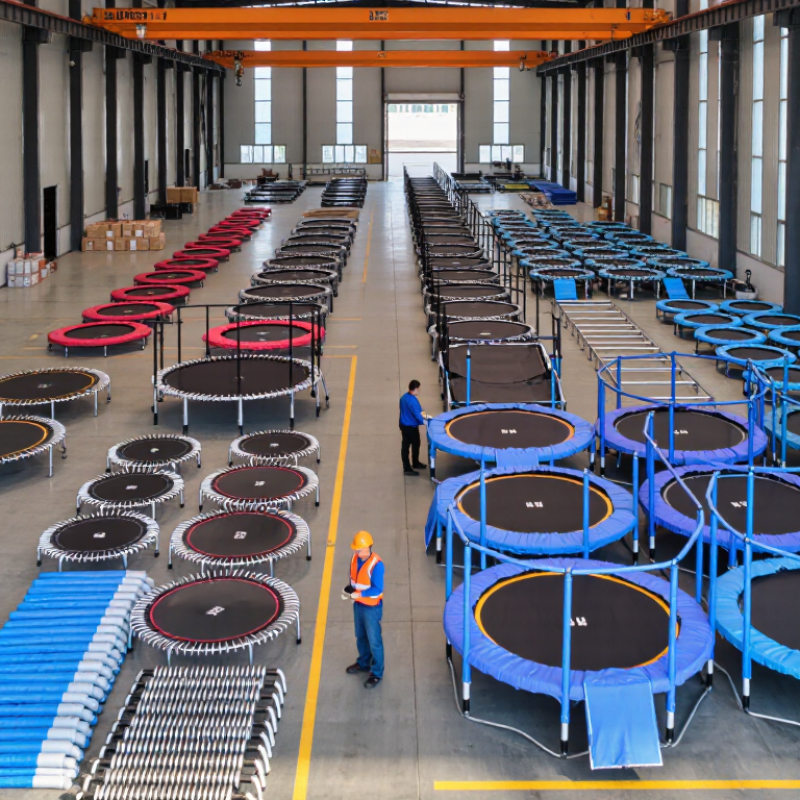
Industry Scope and Selection Criteria for China’s Trampoline Manufacturers
China’s trampoline manufacturing industry covers home models, indoor play equipment, fitness products, outdoor commercial units, and custom OEM projects. Factories may supply complete trampolines or separate parts, including frames, springs, mats, safety nets, ladders, and packaging. This range matters because a supplier experienced in backyard products may not understand heavy daily use in a recreation center.
A practical evaluation starts with construction details. Inspect frame steel thickness, weld consistency, surface treatment, spring coating, mat stitching, and net attachment points. Ask for load testing records and production photographs, not only polished showroom images. During factory visits, check whether workers follow written inspection steps and whether rejected parts are recorded. Small details matter. A loose label can signal weak traceability.
Reliable suppliers explain applicable safety requirements for the destination market and provide current test documentation from qualified laboratories. Verify the report number, product model, test scope, and issuing body independently. Review material declarations, warranty terms, spare-part availability, carton strength, and container loading plans. Production capacity should be measured through recent orders, staffing, and equipment, not promises alone.
Communication is another selection criterion. Clear drawings, signed samples, change-control records, and realistic lead times reduce costly misunderstandings. Still, no supplier is flawless. A factory may offer strong engineering but limited customization, or excellent quality with slower output. Buyers should document these trade-offs and score suppliers against actual project needs.
| Rank | Anonymous Manufacturer Profile | Primary Product Scope | Typical Size Range | Key Safety and Compliance Evidence to Request | Customization Capability | Quality-Control Priorities | Export-Readiness Indicators | Best Buyer Fit |
|---|---|---|---|---|---|---|---|---|
| 1 | Profile A — Integrated Residential Producer Broad product coverage with in-house frame, mat and enclosure assembly. | Backyard trampolinesSafety enclosuresReplacement parts | Approximately 6–16 ft residential formats; confirm finished dimensions and packed dimensions by model. | ASTM F381 or EN 71-14 test documentation where applicable; material declarations; batch traceability. | Private-label packaging, color options, logo application and accessory bundles. | Weld inspection, galvanized or coated steel verification, spring-count control, mat stitching and enclosure-net testing. | Commercial invoice, packing list, carton specifications, HS-code support and export-packing procedure. | Importers seeking a balanced residential range and repeat production. |
| 2 | Profile B — Heavy-Duty Outdoor Specialist Focuses on robust frames and higher load-bearing recreational equipment. | Large backyard modelsReinforced framesWeather-resistant components | Approximately 10–16 ft residential formats; load limits must be confirmed through model-specific testing. | Structural-load test reports, corrosion-resistance information, user instructions and hazard warnings. | Frame geometry, tube diameter, coating finish and enclosure configuration. | Tube-wall measurement, weld strength, coating adhesion, frame deformation and packaging drop testing. | Container-loading plan, moisture protection, spare-parts list and documented inspection checkpoints. | Distributors prioritizing durability and lower warranty exposure. |
| 3 | Profile C — Compact-Space Manufacturer Concentrates on smaller footprints for urban homes and limited garden areas. | Mini trampolinesSmall round formatsIndoor-use models | Approximately 36–72 in mini formats and compact outdoor models; intended-use limits must be clearly stated. | Applicable toy or recreational-product testing, pinch-point assessment, stability testing and age grading. | Foldable legs, handlebar options, compact cartons and retailer-specific instructions. | Base stability, frame padding, fastener retention, surface durability and carton efficiency. | Barcode and carton-label support, multilingual manuals and small-order assortment planning. | E-commerce sellers, apartment-focused retailers and specialty fitness channels. |
| 4 | Profile D — Fitness and Rebounder Producer Targets low-impact exercise and home-fitness applications. | Fitness reboundersFoldable exercise unitsTraining accessories | Commonly 36–48 in rebounder formats; maximum user weight and exercise restrictions require verification. | Material safety declarations, stability data, fatigue-cycle testing and clear exercise-use instructions. | Mat tension, leg design, handle systems, surface printing and retail packaging. | Fatigue testing, spring or elastic-cord consistency, leg-thread inspection and anti-slip performance. | Instruction manuals, assembly guides, spare feet or cords and product-liability documentation. | Fitness retailers, wellness brands and home-exercise distributors. |
| 5 | Profile E — Kids’ Recreational Equipment Producer Emphasizes child-oriented designs, padding and simplified assembly. | Children’s trampolinesLow-height modelsSafety-enclosure sets | Typically compact to medium residential sizes; recommended age, user number and maximum load must be model-specific. | EN 71-14 for relevant European-market products; applicable chemical, mechanical and flammability documentation. | Colorways, printed mats, enclosure graphics, packaging artwork and age-specific instructions. | Foam-density checks, exposed-edge review, net openings, fastener covers and assembly-error prevention. | Multilingual warnings, traceable production codes and documented corrective-action procedures. | Children’s-goods retailers and buyers requiring enhanced safety documentation. |
| 6 | Profile F — OEM/ODM Engineering Partner Provides product development support in addition to contract manufacturing. | Custom platformsOEM programsODM development | Size is project-defined; confirm drawings, tolerances, prototypes and engineering-change procedures. | Design risk assessment, prototype test reports, bill of materials and revision-controlled technical files. | High: structure, components, packaging, instructions and tooling can be developed to specification. | First-article inspection, engineering validation, change control and pre-shipment sampling. | Non-disclosure process, tooling ownership terms, production timeline and document-control system. | Established brands and importers developing differentiated products. |
| 7 | Profile G — Value-Oriented Mass-Market Supplier Optimizes standard models for competitive landed cost. | Entry-level trampolinesStandard accessoriesRetail multipacks | Commonly 6–12 ft standard formats; confirm material thickness and actual net weight rather than relying only on catalog data. | Current test reports matching the exact SKU, factory quality records and required market warnings. | Limited-to-moderate color, packaging and accessory customization. | Incoming-material inspection, sampling plan, quantity reconciliation and carton drop testing. | Stable MOQ policy, lead-time records, palletization data and clear payment terms. | Price-sensitive distributors with established incoming inspection procedures. |
| 8 | Profile H — Premium Finish and Design Producer Competes through appearance, materials and refined user experience. | Premium backyard unitsEnhanced paddingDesign-led packaging | Medium-to-large residential formats; confirm color consistency and outdoor-weather specifications. | Product-specific safety testing, UV-resistance information, material composition and warranty terms. | High: coating colors, textile finishes, packaging design and accessory integration. | Surface finish, UV exposure, seam quality, padding recovery and visual inspection standards. | Retail photography samples, packaging prototypes, warranty process and after-sales parts planning. | Specialty retailers and buyers positioned above the entry-level segment. |
| 9 | Profile I — Commercial and Institutional Equipment Supplier Serves supervised venues and higher-frequency recreational use. | Commercial recreational unitsInstitutional equipmentReplacement systems | Project-specific dimensions; confirm site layout, anchoring requirements, user throughput and maintenance access. | Application-specific structural assessment, installation instructions, inspection schedule and risk documentation. | Project engineering, anchoring arrangements, protective systems and site-specific documentation. | Fatigue-cycle testing, anchor strength, component service life and maintenance-part availability. | Installation manuals, spare-part identification, service response process and inspection records. | Indoor parks, schools, resorts and supervised recreational facilities. |
| 10 | Profile J — Component and Replacement-Part Specialist Supports aftermarket repair and product-life extension. | Jumping matsSprings or elastic cordsNets and padding | Component dimensions are model-dependent; require compatibility charts, measured drawings and tolerance data. | Material specifications, tensile or fatigue data where relevant, chemical declarations and installation instructions. | Cut-to-size mats, spring dimensions, net geometry, color matching and package labeling. | Dimensional inspection, tensile consistency, stitching strength, corrosion protection and fit testing. | SKU traceability, compatibility matrix, small-batch ordering and organized spare-part packaging. | Repair networks, retailers with after-sales service and marketplace sellers. |